
Costa Rica
Members
In addition, Fundación PANIAMOR has developed significant expertise and sustained work in the prevention of online child sexual exploitation and abuse (OCSEA), addressing emerging risks and forms of sexual violence against children and adolescents in digital environments. This work includes research and evidence generation, awareness-raising, capacity-building for professionals, families and other key stakeholders, the promotion of safer digital practices, and advocacy for stronger institutional, regulatory and private-sector responses to protect children and adolescents from sexual exploitation and abuse both online and offline.
Contact: Sr. Oscar Valverde Cerros
Phone: +506 8449-4977
Address: 50 mts oeste Beguelmens, 2, San José, Costa Rica
Email: info@paniamor.org
Website: https://paniamor.org/
Facts
Costa Rica, being one of the top tourism destinations in Latin America, especially for eco-tourism, is experiencing an increase in the sexual exploitation of children in travel and tourism.
Costa Rican children are subjected to sex trafficking within the country. Reportedly, those living in the north and central Pacific coastal zones are particularly vulnerable.
Resources
-

Collective Action to End Child Sexual Exploitation in the Americas: San José Dialogue Report
Available in: English , Spanish
-

- Travel & Tourism
Protective Environments: a model to prevent child sexual exploitation in travel and tourism context — Colombia case study and Costa Rican experiences
Available in: English , Spanish
-
- Justice
- Travel & Tourism
Latin America – Summary of Recommendations: Legal Interventions in Latin America
Available in: English , Spanish
-

- Travel & Tourism
The Americas – Preventing the sexual exploitation of children in travel and tourism (GARA)
Available in: English , Portuguese , Spanish
-

- Travel & Tourism
The Americas – Protocolo y Decálogo para Guías de Turismo 2022 (GARA)
Available in: Spanish
-

- Justice
- Travel & Tourism
Costa Rica – Lista de verificación legal: intervenciones jurídicas claves en la protección de niños, niñas y adolescentes contra le explotación sexual en el contexto de viajes y turismo
Available in: English
-
- Travel & Tourism
The Americas – Overview of Child Protection Standards for Travel and Tourism
Available in: English , Spanish
-

- Travel & Tourism
Expert Paper – Costa Rica is a Sustainable Tourist Destination Committed to Protecting Children
Available in: English
-

- Travel & Tourism
Costa Rica – Guidelines for tourism companies about how to react in case of witnessing suspicious situations of commercial sexual exploitation of children – Paniamor & the Costa Rican Tourism Foundation Institute
Available in: Spanish
-

- Humanitarian & Migration
- Justice
- Online & Tech-Facilitated
- Travel & Tourism
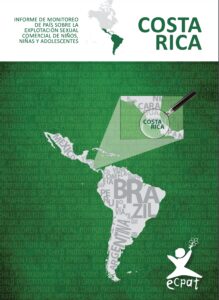
Costa Rica – Country Monitoring Report
Available in: Spanish
News and stories
-
- Justice
- Travel & Tourism
Aperçus régionaux des cadres juridiques et politiques visant à protéger les enfants dans les voyages et le tourisme
-
- Justice
- Travel & Tourism
Regional overviews of legal and policy frameworks to protect children in travel and tourism
-

- Online & Tech-Facilitated
- Uncategorized
Members Spotlight: Fundación PANIAMOR – ECPAT Costa Rica
-

- Travel & Tourism
Preventing the sexual exploitation of children in travel and tourism (GARA)
-

- Uncategorized
ECPAT International mourns death of Fundación Paniamor Executive Director, Gilda Pacheco



Indicators
Age of Consent
No
The age of sexual consent is 15 years for both girls and boys. The national legislation provides for a five year close-in-age exemption for minors from the age of 13 years old or 7 years, for children from the age of 15 years old.
Analysis of country legislation on age of sexual consent, 2024
Extraterritoriality & Extradition
Partial
Active extraterritoriality is provided for SEC-related offences but it is required that the offender is located in the territory of Costa Rica and that the proceedings are initiated by request of the competent bodies. Double criminality is not required.
Extradition requires a minimum gravity of one year (covering all SEC-related offences) and requires double criminality.
SECTT Legal Checklist Costa Rica, 2020
CSAM Definition
Not Yet Assessed
Background Check Required
Partial
The national legislation includes a non-mandatory provision for criminal background check. There are no legal provisions prohibiting convicted sex offenders to hold positions involving or facilitating contact with children.
SECTT Legal Checklist Costa Rica, 2020
National Commitments
Partial
Costa Rica has ratified the CRC, the OPSC, the OPIC, the Trafficking Protocol and the the ILO Convention No. 182.
Costa Rica has not ratified the UNWTO Framework Convention on Tourism Ethics nor the Council of Europe’s Lanzarote and Budapest Conventions.
SECTT Legal Checklist Costa Rica, 2020
Child Advocacy Centers
Not Yet Assessed
SEC Police Unit
Not Yet Assessed
Protection Standards Travel and Tourism
Partial
Costa Rica has implemented a national code for child protection in travel and tourism as a non-binding requirement for industry operators.
SECTT Legal Checklist Costa Rica, 2020
Public SEC Case Data
Not Yet Assessed