
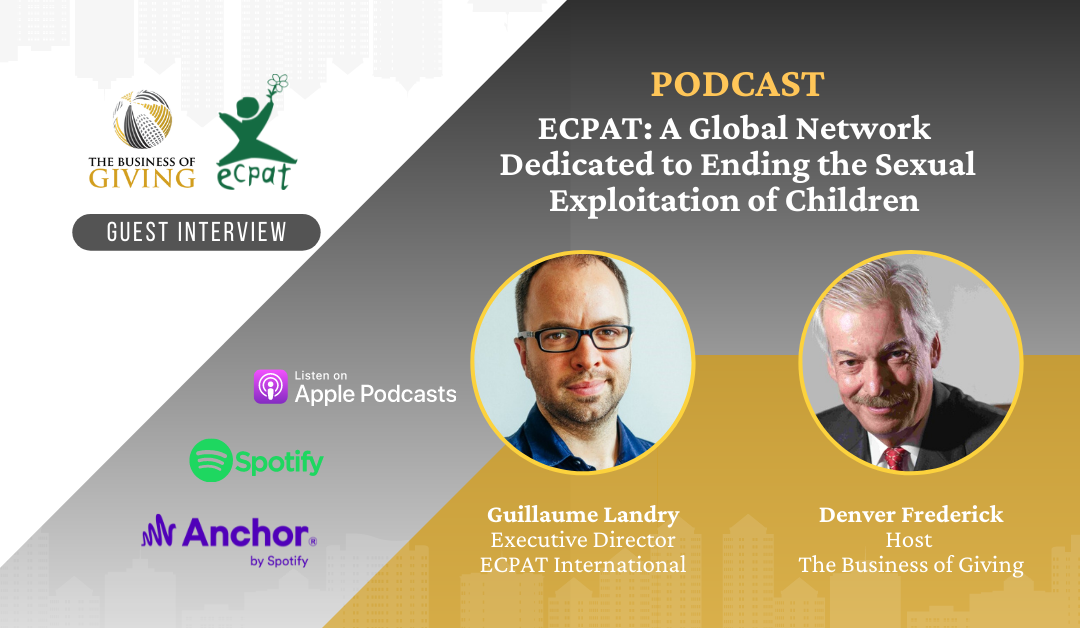
Image credit: The Business of Giving 2022
In April 2022, Guillaume Landry, ECPAT’s Executive Director, joined Denver Frederick, host of The Business of Giving Podcast, in a discussion on ECPAT’s work, the impact of our members, and the global trends ECPAT’s research has uncovered in the field of child sexual exploitation.
Listen to the full episode with the accompanying transcript below, as published by Denver Frederick.
Denver: ECPAT International is a leading global network exclusively dedicated to ending child prostitution, child pornography, and the trafficking of children for sexual purposes. They advocate for change by putting the crime of child sexual exploitation onto global, regional, and national agendas. And here to tell us about their work and the impact that it is having is Guillaume Landry, the executive director of ECPAT International.
Welcome to The Business of Giving, Guillaume.
Guillaume: Good morning.
Denver: Tell us what ECPAT stands for and how the organization got its start.
Guillaume: In the ’90s, there was a group of people who gathered in the north of Thailand to address a phenomenon that was not so new, but that was really deserving more attention. This idea that people from richer countries would travel to countries of lower economic situation with the purpose of exploiting children sexually.
And so that began with the acronym, End Child Prostitution in Asian Tourism. That’s the origin in 1990. Now more than 30 years after, of course, momentum was gained, and we clearly realized that this is not just a question of travel. It’s not just a question of Thailand, although in the imagination, it’s perceived as a hotspot, but certainly we understand that the manifestations are diverse.
All countries in the world are affected, so that has really built the momentum. Today, being a network of over 120 organizations across over 104 countries, this really demonstrates the global extent and manifestation of sexual exploitation of children.
Denver: Wow. The ECPAT secretariat is based in Bangkok. Now tell us about a secretariat and how exactly that works.
Guillaume: Yeah. It’s because of historical reasons that we’re based in Bangkok, but technically, ECPAT International, the secretariat, is not focused on the Thailand situation. So it’s really serving the entire network and its global perspective. So it means the members of the one working directly in the field, some of them provide direct services to children. Some of them might be focused on training, advocacy, developing all sorts of material, whatever is the focus of those organizations.
But the secretariat is there to add value to their work and in particular, it’s to see how globally we can affect the agenda, draw more attention to emerging issues. So that’s the specific space that we try to occupy, having about 25 staff members, a good number being based in Thailand, others across the world, but really affecting global and regional dynamics on those issues.
Denver: Let’s talk about global. What is the scope of this problem? I know it’s probably just a guesstimate, but how many children are exploited in the commercial sex industry or pornography worldwide?
Guillaume: It’s a tough question because everyone would like big figures that demonstrate the magnitude of the issue, but by definition, we’re addressing something that is underreported or underexamined. So it’s always sensitive to really get the appropriate extent of the problem. So we know that much of this is on the increase. So we’ve got statistics and data and evidence coming from the trafficking for sexual purposes aspect of things, for instance, or the technology-facilitated exploitation of children.
But there is also good news in some regions of the world where we see that child marriage is on the decrease. There are certain forms of sexual exploitation and street prostitution in some countries that are also on the decrease. But globally, we see that there is a drastic surge. There are more children being victimized.
And the risks are being increased as well because the global dimension of things, whether it’s because of the increase pre-pandemic of travel and tourism, for instance, that exposed more children to sexual exploitation, or the presence of technologies in the life of children that expose children to grooming, to sextortion, to being exposed to producing material of visual viewing, the child sexual abuse material and so forth. So this is where you get into the complexity of those dynamics.
Denver: Let me pick up on travel and tourism because as we alluded to before, you guys were at the forefront of that in developing the code of conduct for protection of children from sexual exploitation in travel and tourism. But as you sort of said there a moment ago, travel and tourism is changing. And as a result of it, there’s been a sharp increase in the number of children being sexually exploited. Tell us a little bit about that. How is it changing and why are we getting this outcome?
Guillaume: ECPAT piloted a global study on the phenomenon a few years ago. And what we found out is that clearly there is the mainstream aspect of it, is that you have someone who, on purpose, travels from a destination to another, and they do that because of the intention to sexually exploit children. But the findings also demonstrate that the majority of people are not necessarily traveling for that intention. It’s more circumstantial exploitation while being there, in all sorts of circumstances, they end up sexually exploiting children.
It doesn’t take away the level of responsibility and seriousness of the act, but it’s also important to understand the complexity of the phenomenon. It’s important also to understand that a lot of it, and that’s why the expression changed, before it used to be called child sex tourism, and now we talk about sexual exploitation in travels and tourism.
So it is not only the purpose of people changing from one country to visit another country, and then having sexual exploitation in that regard, but it can be the travelers within the country. So we’re talking about transports industry. We’re talking about humanitarian diplomats, military personnel. We’re talking about voluntourism, which is on a sharp increase. People who want to travel and they want to get a purpose. They want to contribute. They want to be in contact with the population.
One of the most attractive features of those kinds of experiences is getting close to the children, going to the school, volunteering in orphanages, and realizing that there’s no control of those people. And then you see the magnitude and the increase in the sexual exploitation of children on those venues. So it’s all of those matters that need to be carefully taken into account. There is the leisure aspect, but the travel aspect is critical, and the domestic travel, too.
Denver: Yeah, those are interesting insights. Some of the traveling that’s going on is involuntary at the moment, and that would be the refugees leaving Ukraine. Women and children, you see them. I hear stories at the Polish border, at the Romanian border, and things of that sort. Tell us a little bit about what’s going on there and what you guys are trying to do to help address it.
Guillaume: Yeah. What’s a bit frightening is to see how we keep repeating the same pattern, is that we’re waiting for it to happen. And then we’re looking for someone to document the story and demonstrate that there is a problem. But what we know globally is that it’s a systemic and systematic problem, whether you’re looking at the situation of Syria and the people that have left and have been constantly sexually exploited along that journey, whether you’re looking at people leaving Congo for migration purposes, and all the way to Morocco are being sexually exploited.
It’s Central America… it’s the stream towards South Asia as well. This is a core problem, but we still see it as something that surprises us, and then we’re reacting to it. And that’s a problem to me, is that really we need to see sexual exploitation of children as something that is systemic and systematic, and therefore deserve preparedness. Deserving the response, rapid measures to address that risk and put the actions in place. And that requires a lot of what you need to address sexual exploitation in the context of migration. But in all other contexts, is to have a strong child protection system.
What ECPAT is doing is to work with border patrol, with the police officers, with the social workers, with those NGOs working in the streets with different people, with the business sector. Just interesting to think that a lot of those people are in contact with the taxi industry. They stay in a hotel; they go into the bus stations with the private buses, moving people from a place to another. How are we making those people equipped with the skill to recognize risks, to know what to do, so that we just break that tolerance that it’s happening?
But I don’t know what to do. I don’t feel concerned. I don’t trust that my actions will lead to actions. These are the small things that oftentimes actually don’t need a lot of money. It’s about skills. It’s about a feeling that I’m part of my society; can I do something to make a difference?
Denver: Yeah. As you say, any time there is a level of chaos and a mass of people, you can pretty much predict that this is going to happen. So just be ready for it, as opposed to… And you’re right, there’s news accounts like breaking news, and as you’re saying, this is as predictable as the rain, you know what I mean? It really is. Reports of child sexual abuse material online have increased 15,000% over the last 15 years. Now, a lot of that is probably the ubiquitousness of the internet, but that still is mind numbing. How can platforms be held accountable for this?
Guillaume: What’s fantastic is at the moment, we examine the movement of change. So we’re looking at the US, the United Kingdom, Canada, Australia, have examined the beginning of new regulations to hold the technology sector accountable. And I’m talking not only what comes to the mind of people, of the social platforms, but also the gaming industry, the service providers.
There’s a complexity of that network of businesses that have so far operated under the idea that it’s a loose context and they will self-regulate. And we have evident outlook that it failed. It failed just by the sheer number that we’re seeing at the moment. And right now, the European Union is going to present legislation in two weeks of time, that will offer an opportunity on a large scale because of the influence of the European Union to make mandatory reporting, detection, withdrawal of all of those forms of material by those companies.
So there is now an era where regulation is needed so that it’s not just left to the desire and the good intention of those sectors to address the issue, but for the state and the private sector to work together. The technologies exist. It’s a matter of just applying them so that we can filter… we can do what’s the right thing, and make sure that children’s right to privacy and children’s right to protection should be combined.
It’s not in a position… It needs to come forward together. And there are elements like safety by design, privacy by default. These are movement that we hear about, but how are we embedding it in as an obligation for those companies? Really, I think that’s a critical moment to shift the element that the image that we always have is when we buy a car, as a parent, you don’t check necessarily if the safety belt is really well-built… it’s part of the trust.
Right now, all parents, we’re purchasing computers, materials, devices; we’re going on the internet, and it’s like the parents or the children would be responsible for checking if everything is safe for them, and it doesn’t make sense. So we really need to shift our mindset on this.
Denver: Yeah, absolutely. And I think there was a debate, wasn’t there, around the Digital Services Act where the protections were going to be for platforms, which were primarily used by children and not others, which doesn’t really make a lot of sense as far as my perspective is concerned because how can you control what platform a kid is going to be on when they’re on the computer?
Guillaume: And what we see as clear evidence everywhere is the children tend to know more about technologies than the adults. There’s a generational divide, so it’s ridiculous to think that children would be limited and going to sort of boring children-oriented platforms. They’re really browsing those technologies far further than actually the adults do.
What’s fantastic is that UNICEF, INTERPOL, and ECPAT have led substantive projects over the past three years in 13 countries with direct interviews with over 1,000 children per country, household surveys, and all sorts of research. So it’s primary data evidence that demonstrates how the children are exposed to harm online, and how they don’t trust the system to be able to support them, how they’re not reporting to their very parents what’s going on.
So the vast majority of those situations where children are harmed just go simply unreported by anybody. So it stays with the children, or at best the people children will trust to share the experience that they had is other children. So there’s a problem as well that even if the data that we have from the National Center for Missing and Exploited Children (NCMEC), and others to demonstrate the extent and manifestation of the child sexual abuse online and all of that is great; it’s just the tip of the iceberg.
So reconciling as well how children today are exposed to that, how the digital literacy on making sure that children are equipped with the skills to be safe online, how are they educated about sexuality as well, there’s a lot of elements that are missing, and we’re just left in the limbo where it’s up to the children to combine all of those elements that we’re not providing them with.
Denver: Guillaume, how do gender norms influence a child’s sexual exploitation?
Guillaume: Greatly. There’s two dimensions to it, well, more than two, but one first angle that clearly by and large, girls are victimized because they’re girls. And because simply in our society, being a girl means that you’re exposed to more risks, and the society is tolerating those risks. So everywhere, you see girls being constantly, repeatedly, systematically exposed to those risks and victimized for that reason, and revictimized when it’s time to access the services they should be, they have a right to access.
Also very important, ECPAT has been the leading movement to pay attention to the situation of boys because boys too are exposed, then are victims of sexual exploitation. And it’s not just a marginal phenomena. It is quite important, and so the extent of it is significant, but by and large, it’s such a taboo that there is no space to discuss it. The boys that are victims of it don’t have services that are tailored to their realities.
So by and large, should that be evidence, should that be known to someone, we will blame the child because of the perspective that this means they are homosexual and in many societies, that’s bringing all sorts of legal or cultural sort of challenges, which has nothing to do from the fact of being victim of sexual exploitation.
It’s not related to their sexual identity or gender identity. And by and large, what we realized is that the services, even in societies that have resources, the services are not adapted to deal with the different trajectory and experience that boys have. So really when you look at the gender dimension, there’s a lot of complexity, and we fail to address those realities.
Denver: Tell us a little bit about the Child Advocacy Center model, which is trying to, I guess, prevent retraumatizing these children at a later date. Tell us how that works and what you’re trying to do there.
Guillaume: There are different models in Europe. They’re also very strong with the Barnahus. So this idea of approaching sexual exploitation of children with holistic perspective, with a systemic approach, so that every bit of expertise is needed to work collaboratively.
So whether you bring the police, with the social workers, with the lawyer’s perspective, with the community-based actor, with the non-formal actors, so that they can coordinate their actions and prevention. When a child is victimized, can they together make sense of what’s going on and minimize the risk of revictimization?
So these are models that have been going on for a while, but what’s exciting is how decentralized, how more common they sort of become in many countries, and how it makes a difference in the ability of working together. Now, my challenge sometimes is to make sure that… we pay a lot of attention to those things, but how accessible are they?
Sometimes we pay a lot of attention to it, but we’re really talking about a small team of 10 people in the capital, and it diverts attention when we look at the magnitude of the problem. And all of a sudden, we’re just happy that we’ve got those 10 people working together. And that’s great for them, but we need to step up, right?
And the majority of children that are exposed to sexual exploitation, the people that are close to them in their society is the local teacher, it’s the police who are around the corner doing just traffic control. Those people are not trained. We’re not paying attention to it. So we sometimes need to be careful at putting too much emphasis on specialized personnel that have limited reach, whereas the people that are close to the children are not specialized personnel.
So how are we making sure that those nonspecialized people and the frontline workers are equipped with the minimal skills to know what to do and how to refer and how to identify risk and so forth? So there is a shift in our approach to be careful at how we address the complexity and the commonality of the issue.
Maybe the last thing I would mention is that what I find fascinating recently is documenting in countries like Namibia in Africa. How the prevalence is absolutely similar to countries like the Philippines, who in our imagination are a hotspot for sexual exploitation of children.
And now we have the evidence, the data to prove it. So it demonstrates how we need to think of it, not just as something that happens far away or is limited to some destination. It’s everywhere, but our action is not.
Denver: Yeah. That’s why you have a wonderful series on your website, Disrupting Harm, and you do it on a country-by-country basis, because as you say, there’s a commonality, but there’s probably also some very distinctive aspects on a nation-by-nation basis, like everything else.
So again, when you have a problem this complex, this multifaceted, this ubiquitous, how does your organization really try to leverage your efforts to have maximum impact?
Guillaume: With that space, in our era at the moment, we need to have facts. We need to have evidence. So that’s very important, to bring research, to bring data so that we can articulate a conversation. It’s not about emotion, it’s not about opinion, it’s about hard facts. So that’s a critical aspect. And most of the members of our network and in civil society organizations in general have limited capacity to do that, to really do the documentation point of view. So that’s something we add a value to sort of being able to cluster evidence about the extent, the manifestation of the problems, but also the emerging issues.
The second aspect is sexual exploitation of children will always be a moving phenomena. When you become good at addressing one aspect of it, it shifts elsewhere. So how do we stay above that wave and see the emerging trends? So that’s very critical in being able to expand a little bit the understanding.
I’m giving an example. In the Disrupting Harm reports that you’ve just alluded to, one of the interesting phenomena that I’ve considered is the gaming industry. How are we addressing it? How are we making sure that this industry is around the table when we talk about technologies? Because by and large, they say, “Oh, no, no, no, just go to the social media. It’s not so much of a problem for us.”
But what you see is, in the gaming industry, there’s always a chatting section there, and it’s a formidable place to groom children, and then we direct them to another platform. So it’s often a space for grooming of children, in particular boys because the boys are more sort of greater consumers of the gaming industry.
And so there is a responsibility there, but at the moment we have the state of denial saying it’s not particularly there. How are we going to address our artificial intelligence and virtual realities and the evolving nature of those technologies, where again, the children seem to be the guinea pig? Or we’re going to do it, and then we’ll see later if harm is being caused, although we already have emerging evidence that it is a problem.
So how are we sort of staying afloat with the emerging issues and then being able to interest decision-makers, bigger companies, and UN agencies, government at a regional and international level? So this is the space where it’s not always very sexy to work on advocacy. It seems like a very lobbying perspective, but actually that’s what the member needs.
It’s to say as civil society in Cote d’Ivoire or in Guatemala or in Cambodia, I have limited access to those zones of influence and decision-making. So that’s where we try to add a value to support their members, or reflecting at the national level.
Denver: Yeah, I see that you’re using data not to measure what’s happening, but you’re actually using it to drive impact, to have facts to be able to get people to take action on it. And you’re absolutely right with these predators, they go where the kids are, and it’s a moving goalpost. Kids change their habits; technology changes, and they’re going to be one step ahead if they can be, trying to get there and do their evil work. What’s your business model? What are your sources of revenue?
Guillaume: Sources of revenues are diverse. It’s a lot of foundation. It’s a lot of people who just believe in it, believe that we can make a difference. I think we’re a bit fortunate in the sense that ECPAT International, we specialize to begin with. It’s very dedicated to sexual exploitation and where you need… there’s no other network that is really taking the point of your civil society organizations.
So therefore that are very close… the hands into the realities, working directly with children, or at least on those issues at the national level. So bringing those perspectives together globally gives us an edge, gives us a different voice.
We see the ecosystem of organizations that are trying to influence decisions being sort of quite rich, but many of those actors remain based in Europe, North America, having a very Western perspective, and really focused on technological solutions for instance, but they don’t have that reach. They don’t have the presence in those countries. And we do have that presence for over 30 years, so it gives us a credibility at a different angle.
So when we approach… And oftentimes, it is foundations, it is private companies that come to us to say: “This is something that interests us; would you”… And there’s a bit of a tolerance to risk because it’s not so much like we’re going to… you give us that much money and we’re going to save that many lives.
What we can show in terms of results is that influence, that change in the mindset of other decision-makers, or making duty-bearers more accountable, bringing the discourse and influencing how we’re moving towards greater solution… or input interconnected solutions.
So that’s the kind of oftentimes support we’re seeking in finding our organization that will be tolerant to not necessarily wanting their money to go with quantitative results and a photo, that because of my money, I built a shelter or I saved 10 children. It’s about seeing a movement. And so that’s the little bit of the space we’re trying to occupy.
Denver: And that’s a difficult space I would say from philanthropy, because again, you are in a sense a backbone organization, and you’re also somebody who is seeking systems change. And systems change doesn’t happen the next quarter or the next year. And so often, I think you have to get philanthropists to change the way they measure their success, which is” we didn’t feed this many people.” it is essentially a longer horizon, and there’s a lot of education that has to go into that.
Guillaume: And we must be accountable. My point is never, to donors, to say, “No, no, no, because we’re working on prevention, we cannot measure how many children were not sexually exploited; therefore there’s no story to be told.” It’s important if a donor is coming with resources, we need to be accountable to those resources that have been given to us and that responsibility that we hold. But the aspect of being patient… are we making sure that the donor, if they’re just ready to give us resources for one year, we’re doomed to be disappointed in sort of tractions.
So are we getting a couple of years? Are we setting some target? Are we able to get some momentum? Let’s say recently I was speaking to some foundation and saying in the Middle East and North Africa, this is a region where the traction is very low. Civil society engagement is low. The problem is certainly as acute as elsewhere.
It’s not a question of being in competition by saying, “Is it better or worse?” It’s just there as anywhere else. But the policy level isn’t there; the social tolerance is well-entrenched, so there’s not that movement to address the problem. So there’s a sense of responsibility from ECPAT International to say, “There’s a space that we should get closer to such regions and see how we can softly work with the people.”
We will never be able to attack people and then reach success, but it’s to convince and it’s to bring to those fears. And it goes back, one of my strategies oftentimes is go back to the origin of ECPAT. In countries that find it very difficult to talk about those issues, one of the entry points is to say, “Can we talk about tourism?”
Because tourists, it’s a bad person like me coming from Canada, coming to exploit your children. Oh, that’s very bad. You shouldn’t come to my country to do that. Can we at least address that point? So that’s easier as a subject matter to come in. We all know in every country that the majority of people exploiting children by and large are nationals.
But it’s okay to use entry points like this one and build trust and momentum in those directions. So you see that’s where if we have time, we can see that there is a minimal commitment that comes into place. And then in the end, children are just better off, and that’s what we want.
Denver: There’s always interesting apertures to someone’s mind. And essentially, I can’t think of a better one than “those guys,” you know what I mean? And that eventually, it will come around to us, but we’ll start with “those guys,” you know?
Guillaume, this has not been an easy time to be in charge of an organization. And I’d be curious on a couple of fronts. Number one, how do you think the nature of leadership is changing, for an NGO like ECPAT, maybe some of the ways you’ve had to adapt? But also, I’m interested in your workplace culture, because again, it’s been very difficult on the whole front of wellbeing for everybody, no matter what company you work with or any organization, and then you compound it in your situation with a very, very difficult issue. So again, how does your leadership adapt to these times, and how do you assure the wellbeing of your team?
Guillaume: Ah, it’s such an important question, and it’s not an easy one to answer. It’s the sum of so many small little things. I think working from home is a challenge for everyone. I’m totally in favor of it, but it comes at a cost. And in a sector like ours where the issue becomes sometimes heavy and working individually in your own home and having limited opportunity to meet with people and get that support structure and the informality of human relationship is also taking its toll over a period of time.
It’s also the ability to influence. I’ve never taken part, as everyone, in so many Zoom calls and online conferences. I’m becoming more cynical because they are getting more and more organized in a way that it’s all about speaking; it’s not about listening.
So it’s all about having our time. We say what we want; we switch the camera off, and we work on other things. The spaces for real discussion is getting thinner and that’s really sad and dramatic. So how are we building around this so that the human connections remain because addressing sexual exploitation of children is about that?
It’s about the collaboration with these law enforcement authorities with the private sector. And all of it, you can write reports about it. That’s not going to change, but it’s about getting the people, the chemistry to work on, and seeing how we can just start with limited Zoom on certain things and then get the momentum going.
So it is a challenge. It’s a challenge because people, I see the level of impatience as well is greater. The collaboration horizontally between teams is more difficult. I find it’s a system that works greater with hierarchy; where as a supervisor, if my team is scattered everywhere, I can still have meetings with them. I can just make them accountable on what they’re working and vice versa.
But getting teams to work together because there’s not an obligation, it’s an added value, it seems optional, I see that’s a real challenge in organizing and getting that richness. But if you don’t get the advocacy to work with the communication, with the research, and then the support in the regions and things like that, then you’re missing a lot of that richness.
So it’s not a given. I think ECPAT, we’re faced with those kinds of challenges. Sometimes we’re doing better, sometimes we’re doing worse, but that’s the momentum that I’m not too sure if I would say it’s still under construction, so let’s see over time. And people seem to be eager to travel again and go to meeting, and I’d find it to be sad to say this is all about travel and tourism in our own sector.
It’s more than that, so certainly, yes, getting together. I was, last week, in Dubai, for instance, for the World Government Summit and getting the opportunity for so long to meet with other people was exciting after two years of not doing that.
But to how are we being more efficient in using the in-person meeting that is so costly, that involves traveling, and climate changes and all of this in a way that we optimize it, and we optimize as well the… It doesn’t make sense oftentimes to travel the world just to say a five minutes sort of presentation in the conference and then leave after.
So I think we need to be more demanding towards travel and in-person meeting, but we need to also see the specific value in doing that as well. So maintaining an interest and the possibility to get to that point again.
Denver: Yeah. So some of the human connection that I think that a lot of people are missing is at the end of the Zoom meeting. When we used to have meetings, we would walk back to the office with our colleagues and we’d say to ourselves, “Is Guillaume really serious? What did he want us to do?” And we’d say, “Well, I’ll tell you what we’ll do,” but there was that little informal chit-chat. And now what happens at a Zoom meeting goes right up to the hour and you start another Zoom meeting, and you don’t get that little informal “How are we going to handle this?” or” I’ll do this,” or whatever. And that is really lost, and that’s where so much of the work happens.
Guillaume: And how are we mindful and respectful from the fact that this has changed so much the life of so many people in so many different ways? People have changed personal relationship. They lost some loved ones. It brought some sensitivity with their mental health. And you don’t capture all of that in a Zoom meeting.
And so people are left with those complexity. I see movement of personnel, people finding that maybe the best solution is to change job. And that zone of discomfort is on the increase.
So how are we still keeping a human touch to those human resources, the human factor, and the team building? I’m all excited that ECPAT would want to have a staff retreat in June, everyone together. We need to just be together and the program becomes even secondary, right? It’s that…
Denver: Yeah. You’re absolutely right. I did read just last evening that 72% of the people who have been part of this Great Resignation have regretted their decision. And I think there is a lot of” the grass is always greener,” and then to find out it ain’t that green.
Guillaume: And what’s our responsibility as manager to have foreseen that, to have sort of addressed that? In some instances, I’m thinking, geez, I should have done something to prevent the situation where we’re going into. So it’s a challenge for everyone. It’s tough to be a leader in this period of time as well.
Denver: In closing, Guillaume, what initiative that you’re currently working on right now, if successful, would have the greatest impact on reducing sexual exploitation of children?
Guillaume: One of the points that I’m really excited about is zooming on the role of the police. Clearly, I’m not the first one to address this. There’s so many actors that are working on it. But what I find difficult is that we constantly bring the police at the end of the conversation because they are the law enforcement. So we’ll make the decision, and we’ll ask them to enforce.
But in reality, the police is not really a proactive member of the discussion and of the prevention strategy. And we seem to paint them into a corner on some specific aspect. It’s all about the specialized unit to have those computers, and it will use the technologies to detect. And please go ahead, that’s such a great part of the story; it’s important.
But in effect, the police is very decentralized. They’re close to the people, they’re close to the children. They can be part of the problem because of corruption, because of mistrust, because of abuse and all of that, but they have such a potential to be a source of protection and trust.
And we seem to accept that it’s not necessarily the case in the majority of the communities and our societies. So how are we having a bit of a plan so that the police can be part of the bigger picture, the community policing approach? How are we looking at the sustainability of training and stopping that flow of people that keep training them all the time, but it’s not integrated?
There’s no strategy. We don’t know where we’re going. They’re just happy to be trained, but they don’t own it. We need leadership from the police to be part of that conversation to the extent that it’s extremely decentralized, and we value them for the potential that it can play, rather than just being the actors you invited at the end.
So there is such an opportunity to shift our mindset there, but we need to have strategy. And everywhere I go, that’s the part that is missing. The police is reactive. They come to wherever we invite them to be, but they are not a driving force. That’s what I want to change.
Denver: That is really interesting. And it’s very consistent with the other two points you made about travel and tourism and gaming. And that is: We act after the fact, and we never get ahead of the problem. And with the police, instead of afterwards, put them at the forefront before it happens and try to prevent it. It’s almost like the way our health system is. We look at it when people get sick and not stop them from getting sick. It’s a very consistent human trait, I hate to say.
For listeners who want to learn more about ECPAT International or financially support this incredible work, tell us about your website and some of the information they’ll find on it.
Guillaume: I’m very proud of our website. It’s kind of artistic. There’s really a great design by its team of Thai people who are putting a lot of heart into it. So it’s ecpat.org and on it, you can click, it’s an experience. There are different pages. You can see a lot of the data, the research, the evidence. Some of them is geographically-focused so if you’re curious about a particular region of the world, or you’re looking at the thematic, you’re curious about child marriage, you are looking at online exploitation of children or on the profile of boys in particular, so there’s really that combination of thematic and geography.
And then you can see also the extent of the network because they are the one also extremely exciting and in the Ukraine crisis at the moment, you’ll see the fantastic work of the members in Moldova, in Poland, in Hungary, in Germany that are working along the movement of population in Ukraine. And they’re still working at the moment, under the bombs, in the shelter, and they transited the children to Romania where we have other members and all of that.
So, it’s to see as well that local story, that very national story, this is where it’s happened. That’s the most powerful zone, but also connecting the dots. So I think that’s the particularity of ECPAT International, the dimension; it’s the systemic, it’s the sort of the sum of all of those national stories that becomes a narrative.
Denver: Such important work. Well, thanks, Guillaume, for being here today. It was such a pleasure to have you on this show.
Guillaume: Thank you so much, and let’s keep in touch.
Denver: Absolutely.
Copyright Denver Frederick 2022.